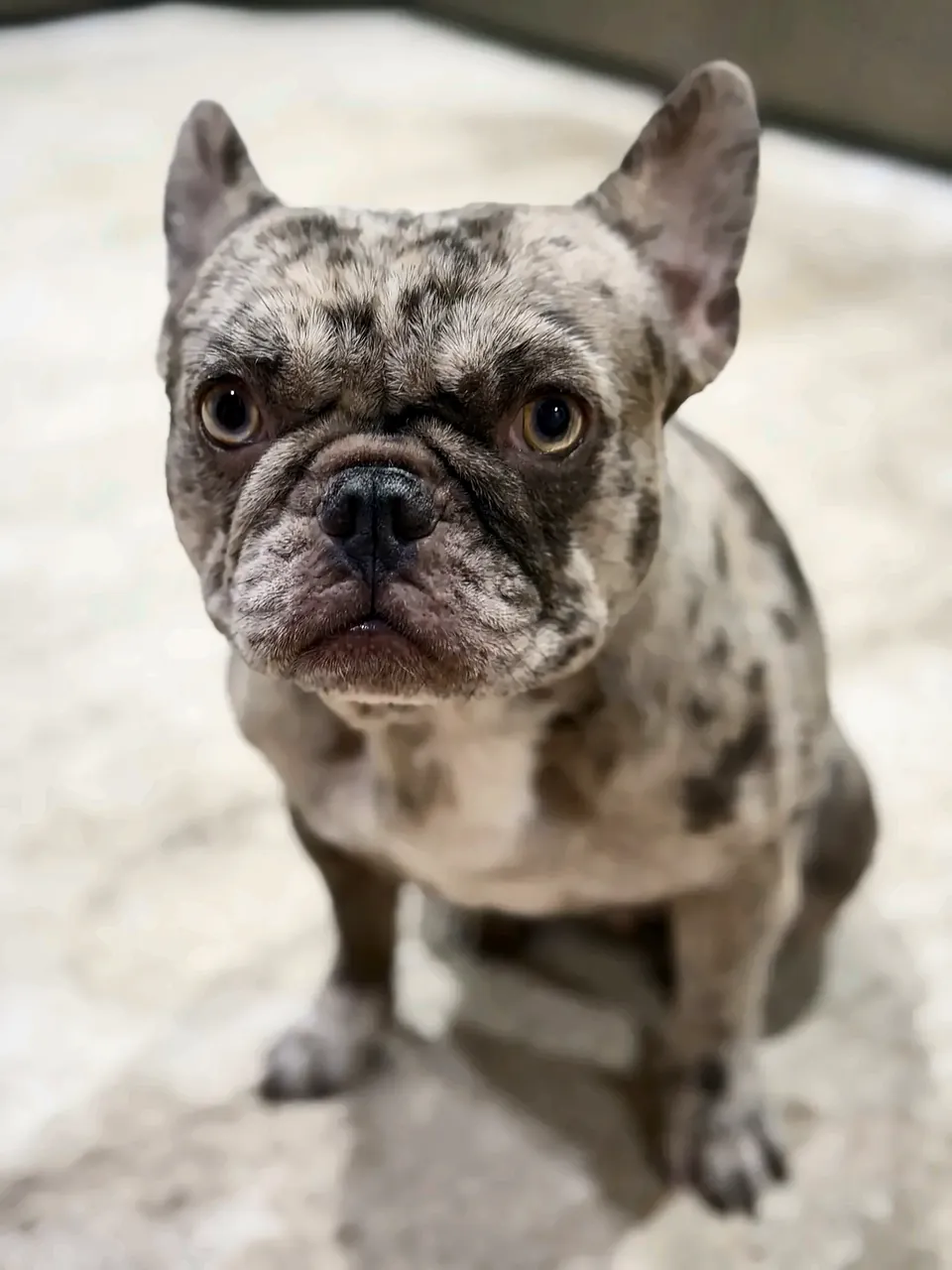
 Maggie the Merle
French Bulldog breathing problems (BOAS)
Heads up: we earn a commission if you buy through links on this page, at no extra cost to you. That never changes what we recommend or the order we list things in. How we make money.
Not veterinary advice. This is general information gathered from veterinary schools and published research. It isn't a diagnosis or a treatment plan. Talk to your veterinarian about your own dog, and if your Frenchie is struggling to breathe, collapses, or overheats, go to an emergency vet now. Full disclaimer.
What BOAS is
The American College of Veterinary Surgeons (ACVS) describes brachycephalic syndrome as a combination of narrowed nostrils (stenotic nares), an elongated soft palate that hangs into the airway, and everted laryngeal saccules (tissue pulled into the windpipe opening). Some dogs also have a narrow windpipe or laryngeal collapse. All of these make it harder to move air, and harder to pant, which is how dogs cool down.
It's common in the breed. A UK study using whole-body plethysmography found 89.9% of French Bulldogs tested were affected to some extent, and 53.9% had clinically relevant disease (Liu et al. 2015, as summarized by O'Neill et al. 2018). The same review notes that only 42% of owners of BOAS-affected dogs think their dog has a breathing problem, which is why noisy breathing is so easy to write off as "just a Frenchie thing."
Signs to watch for at home
The Cambridge BOAS Research Group lists these signs owners should recognize:
- Breathing noise: snoring, snorting or a high-pitched wheeze, sometimes only when excited, playing, eating or stressed.
- Narrow nostrils that pinch closed when your dog breathes in. Cambridge reports French Bulldogs with moderate to severe nostril narrowing were about 20 times more likely to develop BOAS.
- Eating and stomach trouble: gagging, retching, regurgitation.
- Disturbed sleep: struggling to breathe or pauses in breathing while asleep. The ACVS notes many affected dogs prefer to sleep on their backs.
- Heat intolerance: tiring fast and overheating easily.
- Blue gums or tongue and collapse, especially after activity, excitement, heat or humidity. This is an emergency.
Tip: take a short phone video of your dog breathing at rest, after a short play session, and while asleep. It's much easier for a vet to judge noise and effort from a video than from a description.
Heat is the biggest risk
Cambridge explains that a dog's nose does a lot of the work of shedding heat, and an obstructed nose can't do it well. That's why BOAS-affected dogs are prone to heatstroke. Plan walks for the coolest part of the day, keep them short, skip exercise in heat waves or warm, humid weather, and never leave your dog in a car. Our heat safety guide covers the signs of heatstroke and what to do right away.
When to see a vet
Go now (emergency)
- Blue, purple or gray gums or tongue
- Collapse or fainting
- Struggling to breathe, or breathing that doesn't settle with rest and cool air
- Signs of overheating: heavy panting, drooling, vomiting, weakness
Cornell: a dog in respiratory crisis needs immediate transport to a vet or emergency hospital.
Book an appointment
- Breathing noise that's getting louder or happening more often
- Regular gagging, retching or regurgitation
- Snoring with pauses, or restless sleep
- Tiring quickly on short walks
- Before any planned anesthesia, so the team knows about the airway
How vets assess and treat it
Assessment. Narrowed nostrils can be seen on an exam. The ACVS notes that an elongated soft palate and everted saccules can only be confirmed with the dog under anesthesia. The Cambridge group also uses a functional grading scheme based on a 3-minute trot: grades 0 and I are considered clinically unaffected, and grades II and III are clinically affected and need management or treatment.
Management for milder cases (Cornell): keep a healthy weight, avoid excessive heat and humidity, control activity, minimize stress, and use a harness instead of a neck collar.
Surgery for more severe cases (ACVS, Cornell): widening the nostrils, shortening the soft palate and removing everted saccules. Cornell notes earlier intervention leads to better outcomes, and that surgery carries anesthetic risks plus bleeding and swelling. Ask whether a board-certified veterinary surgeon should be involved.
Gear that helps
No product treats BOAS. These just take pressure off the airway and help you avoid heat.
A harness, not a collar
Keep leash pressure off the throat. Choose straps that sit low on the chest and size by chest girth.
Cooling at home
A chew-resistant cooling mat in a shady or air-conditioned spot, plus plenty of water bowls. Cooling gear adds comfort but doesn't make hot-weather exercise safe.
Browse cooling matsWater on every walk
A collapsible bowl or travel bottle makes it easy to offer water often.
Browse travel waterA way to watch weight
Extra weight makes BOAS worse (ACVS, VCA). A measuring cup or kitchen scale for meals keeps portions honest.
Browse food scalesMaggie's snorts
Maggie snorts, and in our house it's a sound we love. It's also exactly why we wrote this page: snoring and snorting are things to mention to your vet, not just enjoy. For walks she wears a Voyager Step-In Air vest harness.
FAQ
Is snoring normal for a French Bulldog?
It's common, but the University of Cambridge BOAS Research Group says dogs with a normal upper airway breathe quietly, and that snoring and snorting are signs of airway obstruction. "Common in the breed" isn't the same as "nothing to check." Mention any breathing noise to your vet.
What are the emergency signs?
Blue or purple gums or tongue (cyanosis), collapse, or struggling to breathe. Cornell's College of Veterinary Medicine says a dog having a respiratory crisis needs immediate transport to a vet or emergency hospital. Overheating signs (heavy panting, drooling, weakness) are also an emergency. See our heat guide.
How is BOAS graded?
The Cambridge group uses a functional grading scheme based on a 3-minute trot. Grades 0 and I are considered clinically unaffected; grades II and III are considered clinically affected and need management or treatment. Ask your vet whether a grading assessment makes sense for your dog.
Can BOAS surgery help?
For dogs whose anatomy is interfering with breathing, surgery can widen narrowed nostrils, shorten an elongated soft palate and remove everted laryngeal saccules, according to the American College of Veterinary Surgeons and Cornell. Cornell notes earlier intervention leads to better outcomes, and that there are anesthetic and surgical risks. It's a decision to make with a veterinary surgeon.
Does a harness really matter?
Yes. Cornell lists using a harness instead of a neck collar as part of managing BOAS, alongside keeping a healthy weight, avoiding heat and humidity, controlling activity and minimizing stress. Our Fit Finder helps you size one.
Does pet insurance cover BOAS?
Some policies explicitly do, but only if signs first appear after you enroll and after the waiting periods. Compare the details on our insurance table.
Sources
- University of Cambridge BOAS Research Group: recognition & diagnosis (signs, nostril stenosis, functional grading)
- American College of Veterinary Surgeons: Brachycephalic Syndrome
- Cornell University College of Veterinary Medicine: Brachycephalic Obstructive Airway Syndrome (BOAS)
- VCA Animal Hospitals: Brachycephalic Airway Syndrome in Dogs
- O'Neill DG et al. (2018). Demography and disorders of the French Bulldog population under primary veterinary care in the UK. Canine Genetics and Epidemiology 5:3 (summarizes Liu et al. 2015 and Packer et al. 2012)
- Liu N-C et al. (2015). Characterisation of BOAS in French bulldogs using whole-body barometric plethysmography. PLoS ONE 10(6): e0130741
- UK Brachycephalic Working Group (2021): heat-related illness consensus statement