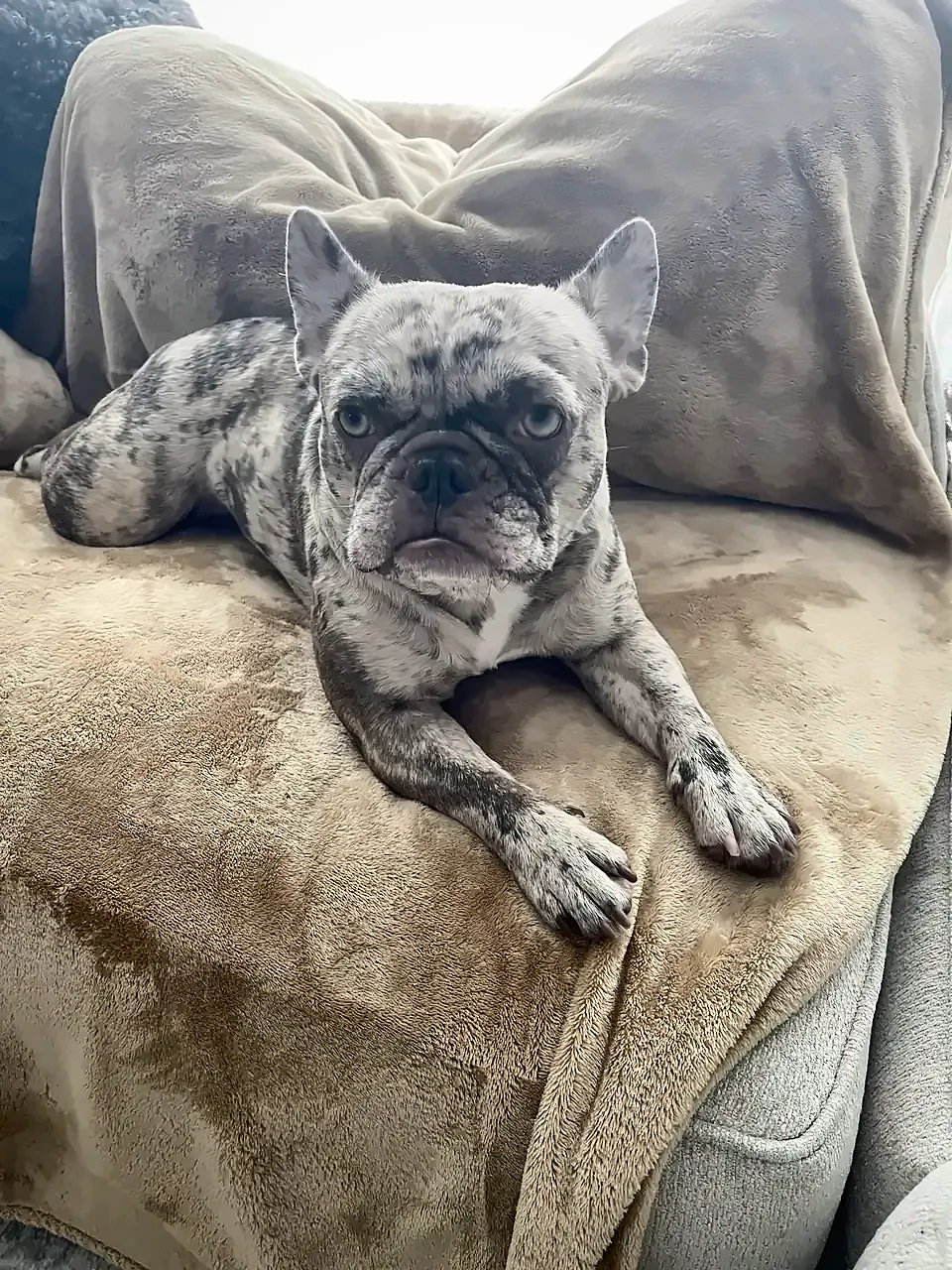
 Maggie the Merle
Heat safety & cooling gear for French Bulldogs
Heads up: we earn a commission if you buy through links on this page, at no extra cost to you. That never changes what we recommend or the order we list things in. How we make money.
Not veterinary advice. This is general information gathered from veterinary schools and published research. It isn't a diagnosis or a treatment plan. Talk to your veterinarian about your own dog, and if your Frenchie is struggling to breathe, collapses, or overheats, go to an emergency vet now. Full disclaimer.
Why Frenchies overheat
Dogs cool themselves mainly by panting. A flat-faced (brachycephalic) airway makes panting less effective. The UK Brachycephalic Working Group's 2021 consensus statement, written by veterinary surgeons and researchers, reports that flat-faced breeds are at least twice as likely to get heat-related illness as medium-skulled breeds. French Bulldogs specifically had about 6 times the risk of Labrador Retrievers in the UK primary-care data it cites. It also notes that some flat-faced breeds can overheat at temperatures as low as about 21°C (70°F), and that being overweight makes panting less effective.
Prevention checklist (from veterinary guidance)
- Avoid or cut back exercise in the hottest part of the day, in heat waves, in direct sun, and when it's warm and humid.
- Always bring shade and fresh water.
- Walk on a harness, not a collar (why).
- Keep your dog at a lean body weight.
- Never leave a dog alone in a car, even with the windows open.
- Take extra care with an unfit dog, or one that's unwell or dehydrated.
Emergency: signs and first steps
Signs (Cornell University College of Veterinary Medicine): heavy panting, drooling, vomiting, bloody diarrhea, weakness, confusion, seizures, collapse.
First steps (UK Brachycephalic Working Group and Cornell): stop the activity and get out of the heat. Wet your dog with cool tap water while air moves over them, such as from a fan or the car's AC. Contact a vet immediately and keep cooling on the way. Getting care early improves survival.
How to judge cooling gear
Cooling mats
Look for a chew-resistant cover with no loose gel or beads your dog could swallow, a washable surface, and a size your Frenchie can stretch out on. Put it in the shade or AC. A mat in the sun just heats up.
Browse cooling matsEvaporative cooling vests
These work by wetting the fabric so water evaporates. They tend to help less when the air is very humid. Make sure the vest doesn't press on the throat and that it fits around the chest. Re-wet it often, and take it off if it dries out and starts holding heat.
Browse cooling vestsWater on the go
A collapsible bowl or travel bottle makes it easy to offer water often on short summer walks.
Browse travel waterShade & airflow at home
A cool room, a fan moving air (never pointed at a dog who can't move away), and plenty of water bowls.
FAQ
Are French Bulldogs more likely to get heatstroke?
Yes. In the UK study cited by the UK Brachycephalic Working Group, French Bulldogs had about 6 times the risk of heat-related illness compared with Labrador Retrievers. Flat-faced breeds overall were at least twice as likely as medium-skulled breeds.
What triggers heatstroke most often?
Exercise. In that UK data, 74.2% of heat-related illness events were triggered by exercise, 12.9% by hot weather and 5.2% by being shut in a vehicle. The Working Group's slogan is "Dogs die in hot cars and on hot walks."
What are the signs of heatstroke in a dog?
Cornell's College of Veterinary Medicine lists heavy panting, drooling, vomiting, bloody diarrhea, weakness, confusion, seizures and collapse. Treat it as an emergency.
What should I do if my Frenchie is overheating?
Stop all activity, get into shade or air conditioning, wet your dog with cool tap water with air moving over them, and contact a vet right away. Cornell advises cooling on the way to the hospital. Don't let your dog inhale water.
Do cooling vests and mats make summer walks safe?
No. They can add comfort, but they don't replace avoiding heat. Veterinary guidance is to skip or cut back exercise in the hottest part of the day, during heat waves, and when it's warm and humid.
Sources
- UK Brachycephalic Working Group (2021): consensus statement on preventing heat-related illness in dogs
- Hall EJ, Carter AJ, O'Neill DG (2020). Incidence and risk factors for heat-related illness in UK dogs. Scientific Reports 10:9128
- Cornell University College of Veterinary Medicine: Heatstroke, a medical emergency
- IVC Journal: helping clients manage BAS in their dogs